

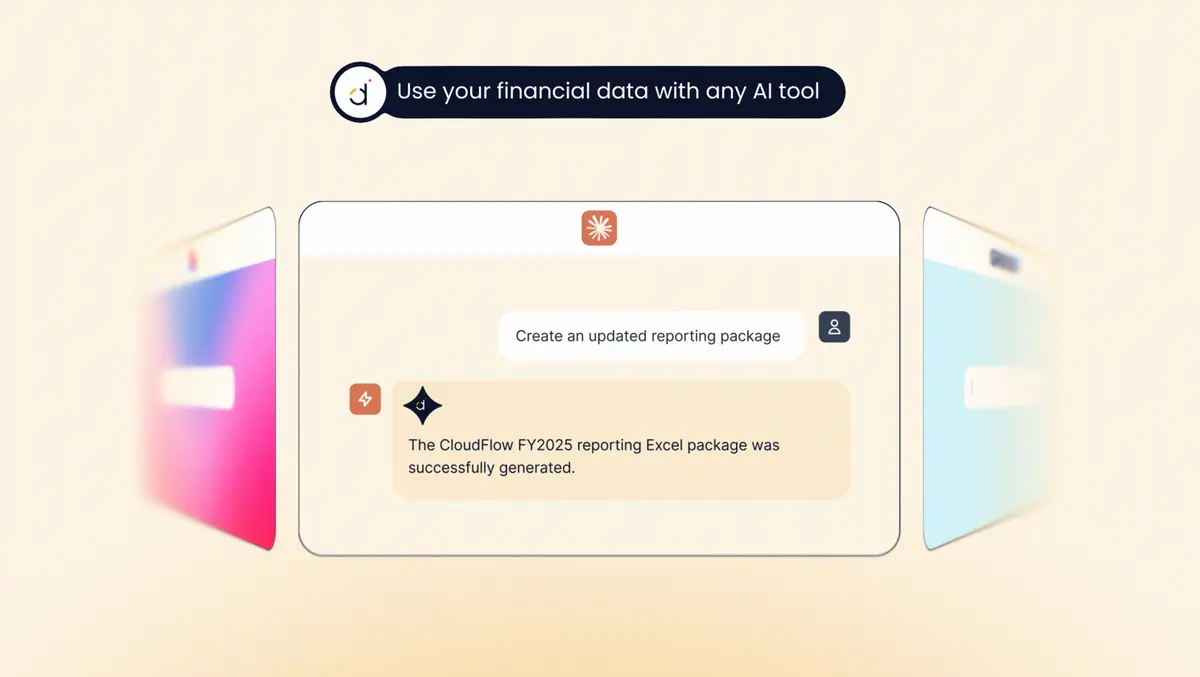
Datarails unveils FinanceOS to power AI-driven finance
Thu, 12th Mar 2026%201.webp)
Datarails has launched FinanceOS, a finance operating system that links consolidated finance data to a range of artificial intelligence tools through a dedicated connection layer it calls a finance MCP.
The product is positioned as a move away from traditional financial planning and analysis platforms, focusing on governed access to current data and the ability to run AI-driven workflows across finance teams.
Data layer focus
FinanceOS centres on a unified data layer that brings together financial and operational information. It adds controls such as audit trails, role-based permissions, and governance features that finance leaders typically require when data feeds, reporting and decision-making.
FinanceOS connects financial data to AI engines through the Model Context Protocol, a method for passing structured context from systems of record to AI tools. Datarails describes this as an execution layer between the database and AI-generated outputs.
The product supports connections to third-party AI services, including Claude, ChatGPT, and Microsoft Copilot. Gamma, Lovable, and Base44 are also listed as compatible tools.
Use cases
Datarails outlined a set of scenarios it expects teams to run on FinanceOS, including board-ready financial reports and presentations, live forecasting and scenario analysis, automated month-end close activities, and accounts receivable agents.
The platform is also designed to orchestrate finance operations with auditability, addressing concerns that ad hoc AI usage can reduce traceability and control once data leaves governed systems.
Many finance teams already use AI assistants for analysis and presentation work, particularly in spreadsheet-based workflows. The challenge is often the underlying data, with version control, lineage, and security requirements that differ from other business functions.
Adoption concerns
Datarails pointed to Gartner research on AI adoption in finance, citing a Gartner AI in Finance survey that said adoption rose from 58% in 2024 to 59% in 2025, while 91% of respondents reported low impact from AI tools. Data quality and availability were cited as common obstacles.
The launch message also highlights the risk of pasting data into generic AI tools: audit trails and compliance controls can be lost, and outputs can become stale if the underlying numbers change after the analysis is generated.
FinanceOS aims to refresh data across the environment within seconds of source updates. Datarails also highlights compliance with SOC 2, GDPR, and ISO 27001.
Integrations and deployment
FinanceOS connects to more than 400 data sources across ERP, CRM, HRIS, payroll, and billing systems. Supported systems include NetSuite, SAP, and Sage for ERP, alongside Salesforce, HubSpot, and BambooHR for other operational data.
Datarails says teams can deploy the finance MCP and have it operational within a few business days, using a usage-based pricing model. FinanceOS is available to finance teams of any size.
Datarails will also work with customers on training and design, and offers professional services for custom agents and workflows.
Product positioning
Datarails continues to sell its existing products across FP&A, cash management, month-end close, and spend control. FinanceOS uses the same infrastructure as those products, and Datarails says it will continue investing in them.
The broader argument is that finance teams may rely less on closed FP&A suites for modelling and analysis as AI assistants become more common inside tools such as Excel. Datarails says the constraint shifts from analysis features to data infrastructure and governance.
"You no longer need traditional FP&A tools to build models or run analysis. AI engines like Claude in Excel can generate sophisticated financial models in seconds," said Didi Gurfinkel, CEO and Co-founder of Datarails.
"But intelligence is no longer the limit - infrastructure is. Without a governed operating layer, those models cannot run on real-time, accurate, and fully auditable data in a secure, controlled environment. Datarails FinanceOS provides the operational layer that makes AI-driven finance reliable and scalable," said Gurfinkel.
Datarails also emphasised interoperability with a broad range of AI tools and developer environments, rather than building around a single assistant or proprietary workflow.
"A thriving open ecosystem will accelerate AI adoption in finance faster than any single vendor could achieve alone," Gurfinkel said.