


Revenium launches AI Outcomes for workflow ROI tracking
Thu, 26th Mar 2026.webp)
Revenium has launched AI Outcomes, a tool that links AI agent executions to business outcomes. It adds workflow-level return on investment calculations to the company's software.
The launch extends Revenium's effort to track the economics of AI systems in production, particularly when costs are split across model providers, external application programming interfaces and human review processes.
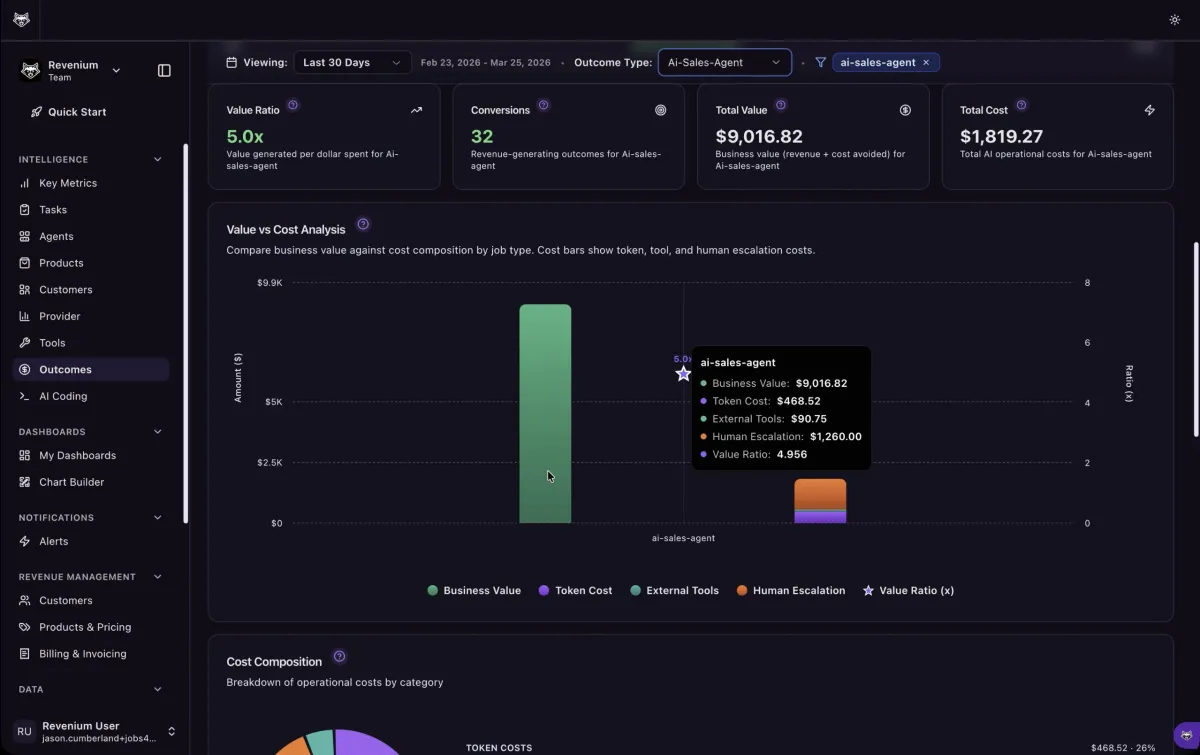
AI Outcomes assigns a shared identifier to each step in an AI workflow, including model calls, tool calls and human review stages. Once the workflow is complete, the system attaches a business outcome to that identifier, allowing companies to compare spending with the result delivered.
Revenium says this enables businesses to calculate measures such as cost per conversion and return on investment for a specific AI workflow, rather than only monitoring token use or infrastructure spending.
The product follows the release of Tool Registry, an earlier offering focused on tracking spending across machine and human workflows. With AI Outcomes, Revenium is seeking to connect that cost data with commercial results recorded elsewhere in the business.
Shared measure
Revenium defines an outcome as a business unit of work carried out by AI, whether a single agent managing a support ticket or several agents handling a loan application. Every operation within that workflow shares the same outcome identifier, creating a single record for the job.
The model separates execution status from business outcome. Execution status is recorded when a task ends and can be marked as success, failed or cancelled. Business outcomes can be added immediately or later, which is intended to suit workflows where the commercial result emerges after the technical process has finished.
Human review steps are included in the same trace, allowing organisations to monitor autonomy rates over time and assess labour savings alongside direct AI costs.
Revenium gave a loan-processing example in which 1,000 jobs generated USD $2,950 in AI costs, produced 780 approvals and created USD $390,000 in value. On that basis, the workflow would show a cost per conversion of USD $3.78 and a return on investment of more than 13,000%.
Economic tracking
The launch comes as companies face growing pressure to justify AI spending beyond technical performance metrics. Many organisations can track model usage and infrastructure bills, but often lack a consistent way to tie those costs to revenue, approvals, support resolutions or other business results.
Revenium argues that AI operations and financial outcomes have typically sat in separate systems, making it difficult for engineering and finance teams to assess a workflow's economics in one place.
"Every AI deployment without outcome tracking is accumulating agent debt. You are spending now against a return you cannot measure," said John Rowell, Chief Executive Officer and Co-Founder of Revenium. "Revenium AI Outcomes changes that."
Rowell's comments reflect a broader concern among corporate buyers that AI projects can move from pilot stages into production without clear evidence of commercial return. Across the sector, suppliers have increasingly focused on governance, spend controls and reporting tools as customers seek tighter oversight.
Jason Cumberland, Revenium's Chief Product Officer and Co-Founder, said the product is designed to create a common metric for both finance and engineering teams.
"AI operations and business outcomes cannot continue to live in separate systems owned by engineering and finance, with nothing connecting them," Cumberland said. "AI Outcomes gives both sides a shared number to work with. Accurate and well-understood costs-per-conversion, autonomy rates, and ROI by workflow are the metrics that turn AI pilot projects into sustainable programs."
Revenium positions itself as a system for capturing AI transactions, assigning costs to the customer, feature, agent and workflow that triggered them, and setting spending limits in real time. AI Outcomes is now available.