

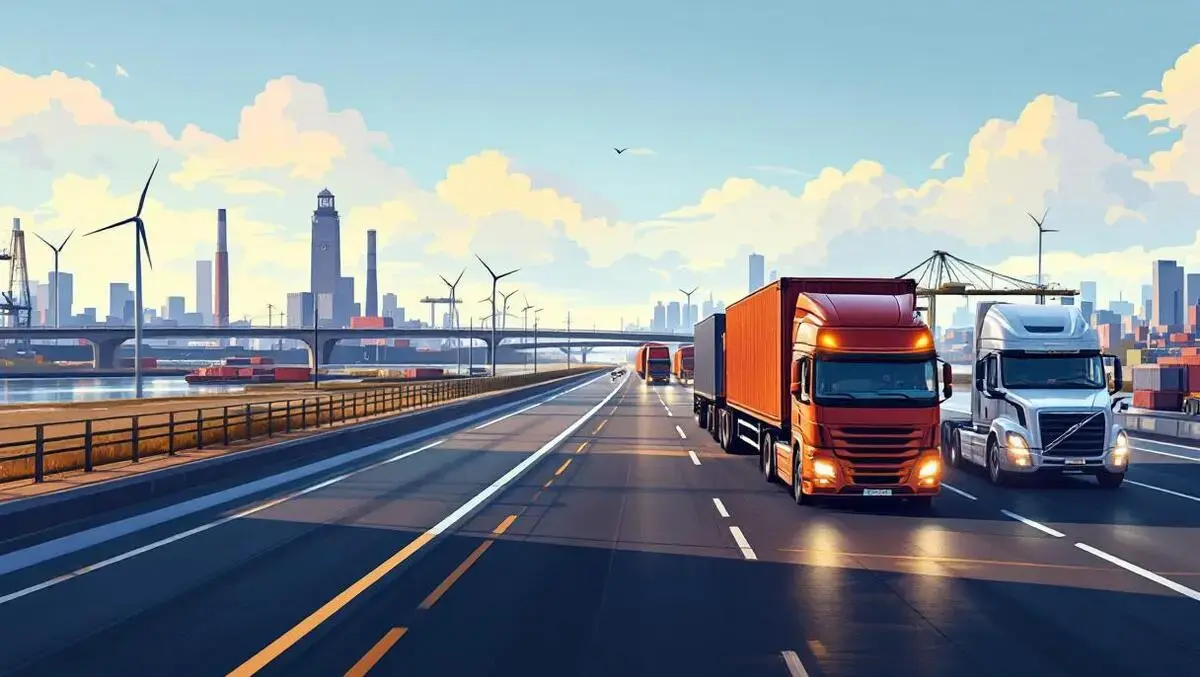
REPS raises USD $23.6 million to turn roads into power
Fri, 22nd May 2026.webp)
REPS has raised USD $23.6 million in an equity financing round to expand its road-based electricity generation system.
The Austrian company has developed what it calls the Road Energy Production System, which is installed in existing road infrastructure and converts the force from passing vehicles into electrical energy. It is initially targeting sites where vehicles slow down or brake, including ports, logistics hubs, industrial sites and urban roads.
Its first commercial installation has been operating at the Port of Hamburg since November 2025. More than 115,000 trucks have crossed the system there, generating more than 6,700 kWh of electricity in six months under live traffic conditions, according to REPS.
The Hamburg project is central to REPS's pitch that wasted mechanical energy from traffic can be turned into a usable source of electricity. The company argues that roads offer a predictable stream of energy at entrances, exits, curves, loading areas and other points where heavy vehicles naturally lose speed.
According to REPS, its converter delivers 254 times the efficiency of the next-best alternative on the market and works regardless of daylight or weather. The system is also designed to operate under heavy traffic conditions for more than 20 years, it said.
Hamburg test
Interest has increased since the Hamburg deployment went live, according to REPS. The company says it is now in discussions with more than 90 parties from the port sector across Europe, the Middle East, Asia and North America, with enquiries also coming from logistics hubs and cities.
REPS has also outlined what broader deployment could look like at the German port. A network of about 230 systems across public roads at the Port of Hamburg, excluding terminals, could generate around 10 GWh of electricity a year, enough to supply about 2,800 households, according to its estimates.
That level of deployment could offset roughly 9.81% of the carbon dioxide emissions caused by port traffic, with a return on investment of less than four years, REPS said. In a much larger urban model, the company estimated that around 64,000 systems in a city the size of Dubai could recover about 3.2 TWh of electricity a year, or roughly 10.8% of the city's current energy consumption.
Justin Karnbach, Chief Executive Officer, Hamburger Container Service, said: "The installation at our facility demonstrates the potential of REPS: where vehicles have to brake anyway, clean energy is recovered and can be used directly where we need it, without any interference with traffic and without additional space."
Jens Maier, Chief Executive Officer, HPA and President of the International Association of Ports and Harbors, said: "We can't wait to see REPS in action - not just in the Port of Hamburg, but throughout the city and far beyond, all over the world. The Port of Hamburg aims to achieve climate neutrality by 2040. HPA actively supports this ambition by implementing innovative technologies. REPS is a future-orientated technology that generates electricity from previously unused energy sources, making a significant contribution toward achieving climate neutrality. With its high volume of truck movements and its role as a central logistics hub, the Port of Hamburg offers ideal conditions to test technologies like REPS under real-world conditions."
Founder's path
REPS was founded in Tyrol in 2023 by Alfons Huber, who left a physics degree and spent 6.5 years developing the technology. That process also involved defending his inventor rights against two universities before bringing the first operational system into commercial use, according to the company.
"Roads are everywhere. Traffic is everywhere. What was previously wasted energy can now be transformed into clean electricity through REPS," said Alfons Huber, Founder and Chief Executive Officer, REPS.
In a separate comment on the financing round, Huber said the company was moving from development to expansion after six years of work on the technology.
He said: "We spent six years developing the technology. Now the scaling phase begins. The strong demand from ports and logistics operators worldwide confirms the need for our solution, and with this financing round we can now scale at the speed required by the energy transition."
The fundraising comes as companies and public authorities look for ways to cut emissions and reduce electricity costs without adding new land demands. REPS is positioning its system as a form of energy harvesting that uses existing transport infrastructure rather than building new generation assets on separate sites.
Elisabeth Zehetner, State Secretary for Energy, Startups and Tourism, said: "Start-ups are no longer a side topic, they are the innovation lab of our economy. This is where technologies like REPS from Austria are created. REPS is innovation made in Austria and showcases what our founders are capable of: they don't just make small adjustments; they transform entire systems. A road becomes a power plant, and existing infrastructure becomes a building block for a sustainable future. Our role in politics is clear: we must ensure that start-ups find the right framework conditions in Austria. With the Start-up Umbrella Fund, we aim to make sure that innovation is financed, developed and scaled here in Austria and Europe instead of eventually returning to us as an import from the U.S. or Asia."